Wednesday, October 22, 2014

Zaat #5

The Black Mole
Mom and Dad
Black Mole can not be called Black Mole for now. With this inconvenience, her parents choose against calling her anything. Silence as usual is easier.


Brother
Now mom and dad are more talkative.


First Mark
Black Mole has become interested in a mark on her right elbow. She discovered it as she, for the first time, tried to brush the back of her hair. Her hair has become smooth and beautiful, much like the discolored and cloud-shaped marking. Black Mole likes to imagine that the sky presented her with this little marking when she was born, but because of the way that the other kids poke the mark and try to fabricate nicknames for her based on it Black Mole begins to wear more long-sleeves.


Skirts
Black Moles enjoys skirts from an early age. Skirts flow and the boys seem to look at her more often. Black Mole finds she likes this.


School
Black Mole doesn’t like school. Math makes her wrists shake. So she is happy when her father takes her out of school, so she can help in the family restaurant. The restaurant smells better than school, turnips and garlic doesn’t make you as nauseous as stale urine and burnt out cigarettes. But Black Mole isn’t happy when her mother puts her back into school. Black Mole still isn’t happy when mom and dad yell. The water in Black Mole’s glass shakes as mom’s head hits the floor.
Black Mole cuts the carrots and boils the water in the restaurant.


Second Mark
Black Moles cuts herself on the finger with the knife she used to peel potatoes.
It is Black Mole’s first time in the hospital and she is astounded by how much is going on around her. There are people crying all over and a man who has six fingers in his right hand because he needs to hold the finger that detached itself from his left hand. That reminds Black Mole of her own hand, so she looks down to inspect. She finds that there is a newspaper wrapped around her left index finger with a string keeping the articles and printed cartoon firmly in place over the oozing red slit. Black Mole’s mom appears in the room and shakes her head. Apparently, no doctors were interested in teenage girl fingers that night.
Black Moles needs to renew her newspaper bandages every day and when she peeks at her finger, she finds a healthy scar forming. She enjoys the scar because it reminds her of the heroes that fight and conquer and end up in the story books.
But her mom’s sadness about the scar’s maring of her daughter causes Black Mole to enjoy gloves.


Cooking
Black Mole liked school.


Husband
His name is Saad. The first time Black Mole sees him is when he came to talk to her father about “something important”. In the bed a week later, he tells her that she actually served him many times at the family restaurant and that he was surprised she didn’t recognize him. Black Mole blushes in embarrassment for him and herself.


Summer
Black Mole doesn’t like summer. It is too hot and now Black Mole can’t take off her gloves and long sleeves because of the man that roams around the house all day.


Third Mark
Black Mole begins to notice a small black dot on her cheek as she washes her face. The beauty mark accents her dimples when she smiles, so she smiles all day, until Saad ridicules the dot because he thinks it is growing.
But this time Black Mole’s long sleeves and gloves cannot help.


Travelling
Black Mole’s husband leads her on a quest for a home. Alexandria, Desouk, and finally Cairo. Black Mole liked Desouk. Cairo is most beautiful when the sunlight is just beginning to fade over the discarded soup cans in the urine-stained ally. So Saad buys them a house so they can look out on this ally whenever they please.


Work
Some newspaper cartoons are quite well written.


First Child
It is a boy and he is named Aziza. Aziza is loud and doesn’t care much for his mother’s sleep. But Saad loves Aziza and congratulates Black Mole on her fine work once he is made. Aziza breaks his first toy. And his second toy. So Black Mole goes to the hardware store around the corner and buys a square of wood. Aziza can’t seem to break his third toy.


The Bus
crashes.


Thursday, October 16, 2014

Zaat #4

1) The content in chapter 14 (a news article chapter) and chapter 15 (a prose chapter), seem to mirror each other. The best example of this is how chapter 14 starts off with clippings from news papers about foods (mostly about diseases caused by food and illegally imported food), and the chapter 15 too starts out with a description of food (in this case it describes why Abdel Maguid decides to stop eating chicken and red meat). A fact that makes this connection even deeper is that both sections which describe food include direct relations to red meat, and the news clippings description of how the meat isn't being allowed to be illegally imported gives some reasoning as to why in the prose section it is said that the meat is expensive.

2) Ibrahim weaves a few criticisms of religion into the newspaper clipping sections of Zaat. One example of this criticism is when Ibrahim places in these sections adds for metal working companies which use "the Name of Allah" in order to sell their services and products: "In the Name of Allah the Compassionate the Merciful/ Al Umma Metals Ltd...make money and guarantee your zakat" (124)

This can also be taken as a criticism of the economy because to us reading these adds, it is clear that these are outlandish ads. It is clear to us that buying from a company won't ensure that you "guarantee your zakat", yet these companies still insist on trying to persuade customers that they are holy companies. This could be taken as a form of satire on the part of Ibrahim, yet these article cut outs are supposedly real, so Ibrahim is only relaying the message.

An example of Ibrahim's criticism of the disregard that Egyptian officials have for their environment is when Ibrahim uses contradiction on page 188. On this page, Ibrahim presents, side by side, reports from the Irrigation Ministry, which continually ensures people that there is "no cause for alarm" with continuing reports on the seriousness of a drought that is occurring. These antithesis makes the Irrigation Ministry look foolish and inept, for in the end they are proven wrong and the drought does have major consequences on the crops in Egypt.

3) Absurdist Literature (writing that focuses in on characters in situations where they cannot find any meaning) is very apparent between pages 197 and 203 when the book takes a more Abdel Maguid-focused approach. In these pages, Abdel Maguid wanders aimlessly around his neighborhood. He almost seems lost and unaware in these pages as expressed in this quote: "Abdel Maguid...meandered into the  middle of the road as he gazed longingly at the gleaming streamlined fenders" (200). This wandering ends with Abdel Maguid becoming fixated on sex. This journey makes us feel that Maguid is searching for something, yet in the end he cannot find anything and so he reverts to hedonistic values.

4) Abdel Maguid grew up as the second son. He didn't get much attention from his parents, so he always chased girls to try find affection. He would every now and then find a girl to show affection to. Alas it would never stay for long

Sunday, September 28, 2014

Zaat #3

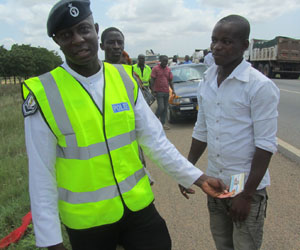
A picture for all you of my 0 followers:


(Obirikorang, Qouphy Appiah. "The Art of Police." SPY Ghana. Web. 28 Sept. 2014.)

This picture of a man paying off a police officer reminds me of the scene when Zaat is watching the man who is called "Doctor". The Doctor goes around, trying to pay off public officials, and as he does so, the officials "pay no attention to him", but instead just take the bribe and sign his papers. This picture reminds me of that scene for the obvious contextual reasons, but also because the apathy on the face of the police officer is how I imagine these bribes to occur.

Now here's a new word you get to learn:

petrochemical

This word's from page 126: "El Shaab newspaper accuses Petroleum Minister - of keeping open the petrochemical complex

The definition of this fine word is: relating to or denothing substances obtained by refining and processing petroleum or natural gas.

And then we have a test question for you:

Analyze whether Zaat is primarily motivated by superficial ambitions or by finding something larger more deep? (include in your answer ample reference to the text)


Thursday, September 25, 2014

Zaat #2

1) Zaat seems to be obsessed with appearances in this novel on multiple levels. She is both obsesses with physical appearance and social appearance.
This obsession with physical appearance  is seen by how we know her coworkers as "Rabbit Face" and "Black Mole"  still even though by this point in the novel, she should have much less superficial names for these two people than labelled based on face structure and a mole respectively. Her obsession with social appearance is shown by how she quantifies selfish; Zaat calls Abdel Maguid "selfish" because he is "more interested in himself and his family" than her "needs for shoes and tiles and other things". Zaat her actually places a higher value on shoes and new tiles than her extended family; she feels that these items that display opulence are more important than family.
The reason why Zaat is so obsessed with appearance may be because much of the news clippings in the novel, which (I believe) represent what Zaat is reading at her job, have to do with appearances. Yet in the news, the appearances are more about how something is perceived than sensed. For example, one string of newspaper clippings in the sixth chapter pertain to a sewage pipeline that is to be built to flow sewage into the sea. And this string of clippings doesn't pertain to facts about the pipeline, but varying farmings of the pipeline in order to shape the appearance of the idea of the pipeline. For example, one article clipping reads that "to pump Alexandria's wastewater into the sea will cost one billion and 160 million pounds. Pumping wastewater out to the desert would cost two billion and 14 million pounds." (96) This article clearly tries to shape the appearance of the pipeline into something the public would benefit from by framing the pipeline as a choice between two, even though the other option is to treat the water and use for irrigation. This is just one of the many newspaper clippings that deal with appearances. This permeation of the idea of appearances in the news may have persuaded Zaat that appearance is paramount.

2) Both the Chapter 4 and Chapter 6 news paper clippings have had a trend. In chapter 4 it was a commentary on the influence of Western powers in the economy of Egypt that seemed to permeate throughout the string of newspaper clippings. The chapter referenced NATO, Mubarak's trip to the US, and GM multiples times, but what was most discussed was US aid to Egypt. In Chapter 6 the reoccurring story was that of the sewage pipeline in Alexandria. This story represented the corruption in Egypt which would allow pay offs to lead to the building of a poorly researched pipeline that leads to the unclean flooding of homes and drowning deaths of dozens. Yet, Chapter 2 seemed to have a much less distinct trend (there was a slight reoccurring story dealing with the Steel Woman and pesticide use, but theses stories were much less defined than the foreign aid in Chapter 4 or pipeline in Chapter 6). This may be due to the fact that that chapter was my first experience of reading only a string of newspaper clippings and trying to find the trend in them, so I wasn't as practiced as I was for Chapter 4 or 6. But I believe that this is more due to these clippings being representative of what Zaat is reading about and to an extent her understanding of the world through the clippings. This would have been Zaat's first experience with the flood of information that newspapers provide and thus the incoherent narrative in Chapter 2 may be due to the confusion that plagued Zaat as she first began to read the newspapers.

3) It seems that the prose sections in Zaat lead up to the article sections. For example, at the end of Chapter 1, just before Chapter two that as mentioned above I believe represents, the confusion Zaat faces, we hear about Zaat struggling with her transmissions. The very end of Chapter 1 describes her as having to "bounce back" after having shed proper and sufficient tears" (20). This section is then followed by the Chapter that as described above represents Zaat persevering through the newspaper clippings. Furthermore, Chapter 3 ends with a description of Anwar El Sadat and Gamal Abdel Nasser's "nocturnal visits" to Zaat, who are both large politicians that have much to do with either rejecting western aid (Nasser) or furthering western relations (Sadat), and thus Chapter 4 is about Egypt's relationship with the western world. Finally, Chapter 6 ends with Zaat urging Abdel Maguid into corruption, questioning the immorality of theft: "Abdel Maguid concluded...'What do you want me to do? Steal?'/Zaat responded without a thought: 'Why not. What's wrong with that'" (92). This passage that describes a scene that could lead into a descent into corruption is placed just before the string of news clippings in Chapter 6 that, as discussed above, deal with corruption of Egyptian officials.

4) The men in Zaat are shown as being driven in a very large part by lust and desire. In chapter 5, Abdel Maguid knocks down a sewing-machine because of his pursuit of a "scenario...[he] had prepared in his mind for the night's entertainment"(87). Zaat in contrast is control of her "engines of lust and desire" because to the "nocturnal visits". This portrayal of women as more control than men contrasts with a widespread misconception (around the world) that women aren't as suitable leaders as men. Thus, Ibrahim's authorial purpose may be to give an impression against this misconception in order to make it clear he doesn't agree with it and that it should be eradicated.

5) In Chapter 5 Zaat begins to cry when dozens of kids that go to her daughter's school die when a train hit their school bus(her daughter was safe because she had stayed home because of a fever). Zaat cried not out of morning or sympathy, but because she should have been one of the mothers who had lost a child. And this may not sound that superficial, but then Zaat blames Abdel Maguid for having not put the daughters in a language school and leaving them in the government school that had killed all those children. So Zaat is not crying because of her fear that her daughter almost died, but because her daughters were not put into a language school. And this is where Zaat's superficiality shines bright.

Sunday, September 14, 2014

Zaat #1

On page 2 of Zaat, we read: "There were other traumatic initiations,some of which illustrated a particularly unique modification of the prevailing custom, such as when they held her down [. . .] and tore out that little protuberance  that has so disturbed the Egyptians since ancient times" (2). This quote about genital mutilation I feel is clearly meant to be shocking. And this is proven by how shocking the scene clearly is, this idea of genital mutilation is something far from most of our minds when we think of the stages of development. But this can also be proven more concretely by the language Ibrahim uses here. He talks quite nonchalantly about he endeavor, using less-emotionally connotative words like "protuberance" and "prevailing custom", thus relying on the innate shock that this process has on the reader. This shock on the second page of Zaat, I believe, is meant to initiate the reader into the culture and context of the novel. The reader must understand quite early on that we are not in Kansas or California anymore. This world that has an expectation that this "traumatic initiation" that Zaat endured would be endured by all female children. And thus we must stop thinking of this custom as something unusually (a more negative word could probably be used here), but as something ingrained in the society we are now entering.

The idea of insider and outsider comes up when Zaat is moved to the archives. There she is very clearly an outsider, with her and her coworkers only sharing a small few seconds of eye-contact before continuing on in ignorance of her: "The moment of mutual eyeing up passed in silence and the staff soon discovered that their new colleague...appeared (as she would always appear to them) insignificant and dim-witted" (17). The idea of insider and outsider is even more enhanced in this quote through the clumping of all of the other workers into a whole that sees Zaat as "significant and dim-witted". Through this separation of Zaat and the rest of her cohorts in the workplace, Ibrahim signify how out of place women like Zaat feel in the workplace. In Egypt, many women are unused to work and are treated as if they do not fit in there. Ibrahim paints this context by exploring the idea of insider vs outsider.

The use of "transmission" and "machine" throughout the first two chapters of Zaat seems to be trying to distance Zaat or the workers in the public workplace from the devices and apparatuses they work with. For example, on page  13, the "printing machine" is described as being "ultra-modern" and "ordered for tens of thousands of dollars". This description of the machines being unusually modern and attainability expensive characterizes them as similar to something foreign. This feeling of being foreign is exacerbated by the implication that the machines actually are foreign, with them needing to be "ordered" from somewhere else. The machines are also characterizes ad being somewhat useless. The machines described on page 13 would end up collecting the ambient dust of the basement they were stored in. These two qualities of the machines as foreign and useless add up to paint a description of foreign objects as things that are shiny, yet useless to the regular person like Zaat.

Friday, September 12, 2014

This Blog

This blog is in English as opposed to other languages. So the title makes sense....